Beyond Data: Why DLP Needs Behavior and Intent to Understand Risk

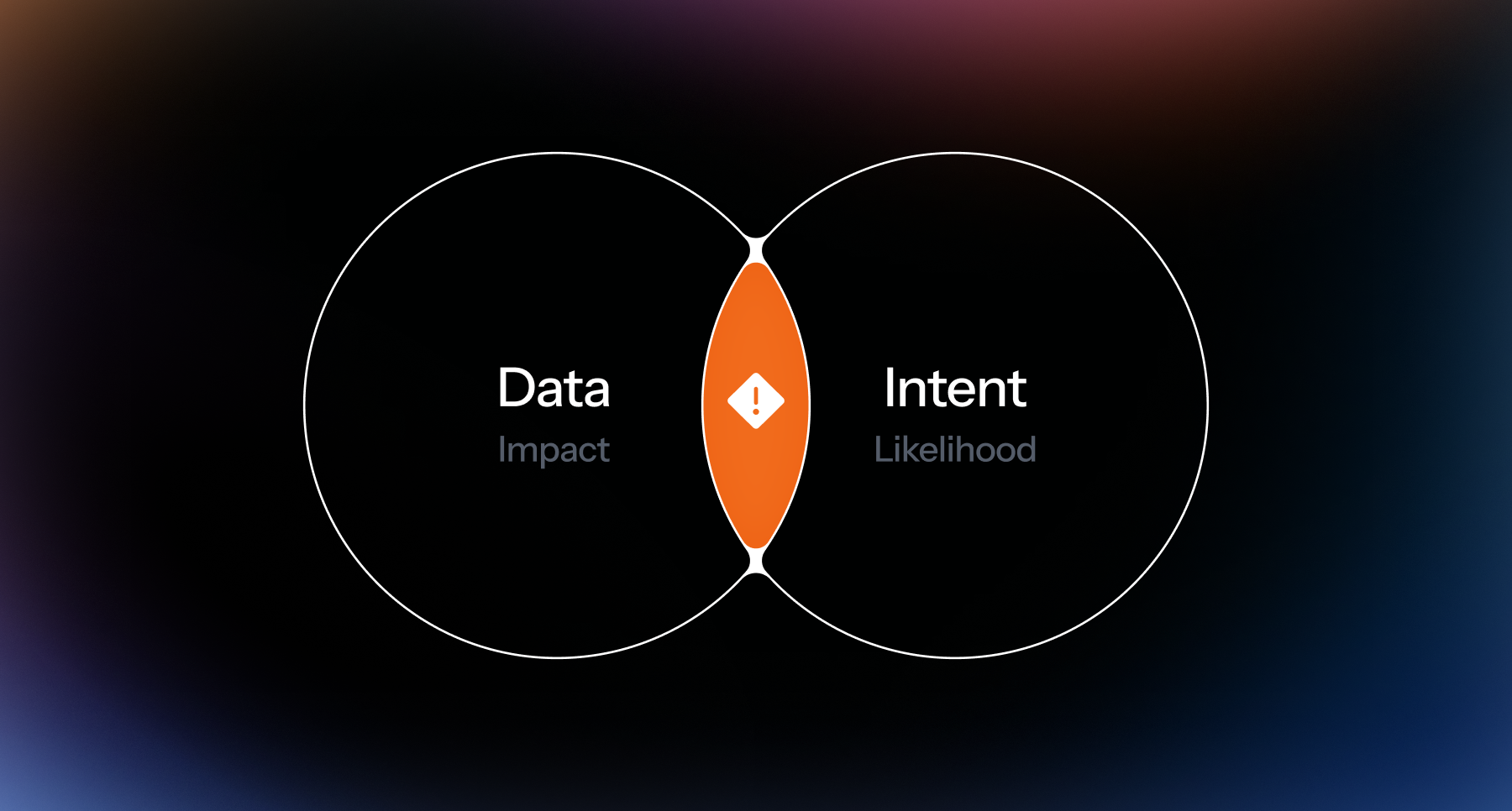
Risk = likelihood × impact
When it comes to preventing data loss, that generally translates into two questions: how likely an action is to be data exfiltration (whether accidental or malicious) and how much that exfiltration would hurt the business (i.e, how sensitive the data involved is).
Historically, we as an industry have tackled those two components separately. Data loss prevention (DLP) was designed to understand and control sensitive data. Insider risk management (IRM) and user behavior analytics (UBA) were designed to understand the behavior and intent of users to spot insider threats.
At Bold, we see those domains converging, and the industry is showing signs of agreeing. Gartner expects that by 2027, 70% of CISOs in larger enterprises will adopt a consolidated approach addressing both insider risk and data exfiltration.
Of course there are use cases for IRM outside of data exfiltration, like fraud or sabotage. And there are plenty of non-malicious exfiltration risks that DLP has always handled, and always will. But when the question is whether data is leaving, we believe you need the full story.
The gap between DLP and insider risk
A highly sensitive file moved as part of necessary work is low risk. A deeply unusual action involving a lunch menu is also low risk. The incident worth acting on is the one where both the data is highly sensitive and the intent is likely malicious.
When DLP measures impact and IRM measures likelihood, each in its own tool, you don't get the full story. The DLP team gets an alert about sensitive data with no idea why it moved. The insider risk team gets a risky user with no idea what they took. Both result in false positives (annoying) and false negatives (risky).
This is also why prevention remains a challenge for DLP. Without the confidence to calculate risk accurately, an organization can’t afford to add friction and risk blocking legitimate work.
To stop data before it leaves, both halves have to be measured in the moment. Two tools reconciling after the fact can explain a loss, but they can’t stop one.
Let’s look at what each half can and can’t tell you on its own.
Impact: what data classification can and can’t tell you
What data classification can tell you on its own:
- What the data is: a financial model, source code, a tax form, a customer list
- How sensitive it is, and whether it falls under a regulation like PCI or HIPAA
- How confidential it is to your business, including proprietary data no vendor could know about
- Enough to act on clear cases, like a financial model headed to a personal account
What data classification can’t tell you on its own:
- Whether a particular movement of sensitive data is an actual problem. Sensitive data moves legitimately all day, and an employee’s own W-2 has to leave sometime.
- Who moved it, or why
- Whether this is normal for the person moving it
Likelihood: what intent analysis can and can’t tell you
What intent analysis can tell you on its own:
- Who the user is, from role and department to departure date
- What they did: where the data came from, how it changed, and where it went
- Whether that’s normal for them, their department, and the company
- When someone is trying to disguise what they’re moving
What intent analysis can’t tell you on its own:
- Whether what moved mattered. An unusual transfer of a lunch menu and an unusual transfer of source code look the same.
- How serious a deviation is, without knowing what the data is
Bold gives you the full picture
Bold runs two AI-powered engines that work together: one to measure impact by understanding the data, and one to measure likelihood by understanding the intent behind what’s happening to it.
Measuring impact: Bold’s Data Classification Engine
Bold’s Data Classification Engine runs small language models on the device to classify content by meaning rather than by pattern. It reads several dimensions at once:
- Regulatory data, content type, business documents, and confidentiality, from a shared model that keeps the footprint small
- Custom classifiers for proprietary data, built from a handful of examples
- External labels from Microsoft Information Protection, Google Drive, and DSPM providers, layered in as additional context
Read how Bold’s AI-powered data classification works →
Measuring likelihood: Bold’s Intent Engine
Bold’s Intent Engine looks at everything that happens to the data, and who’s behind it, to judge whether an action was a mistake or deliberate:
- Data lineage: where data came from, how it changed, and where it went
- Behavior analysis and obfuscation detection: what the user did, including attempts to disguise the data
- Anomaly detection and user context: whether the action is normal for the person, their department, and the company
Read the Intent Engine launch post →
At the speed and scale of AI, understanding risk is everything. It’s what lets teams investigate what matters and, more importantly, stop data loss before it happens.